Types of Whale Watching in Bar Harbor
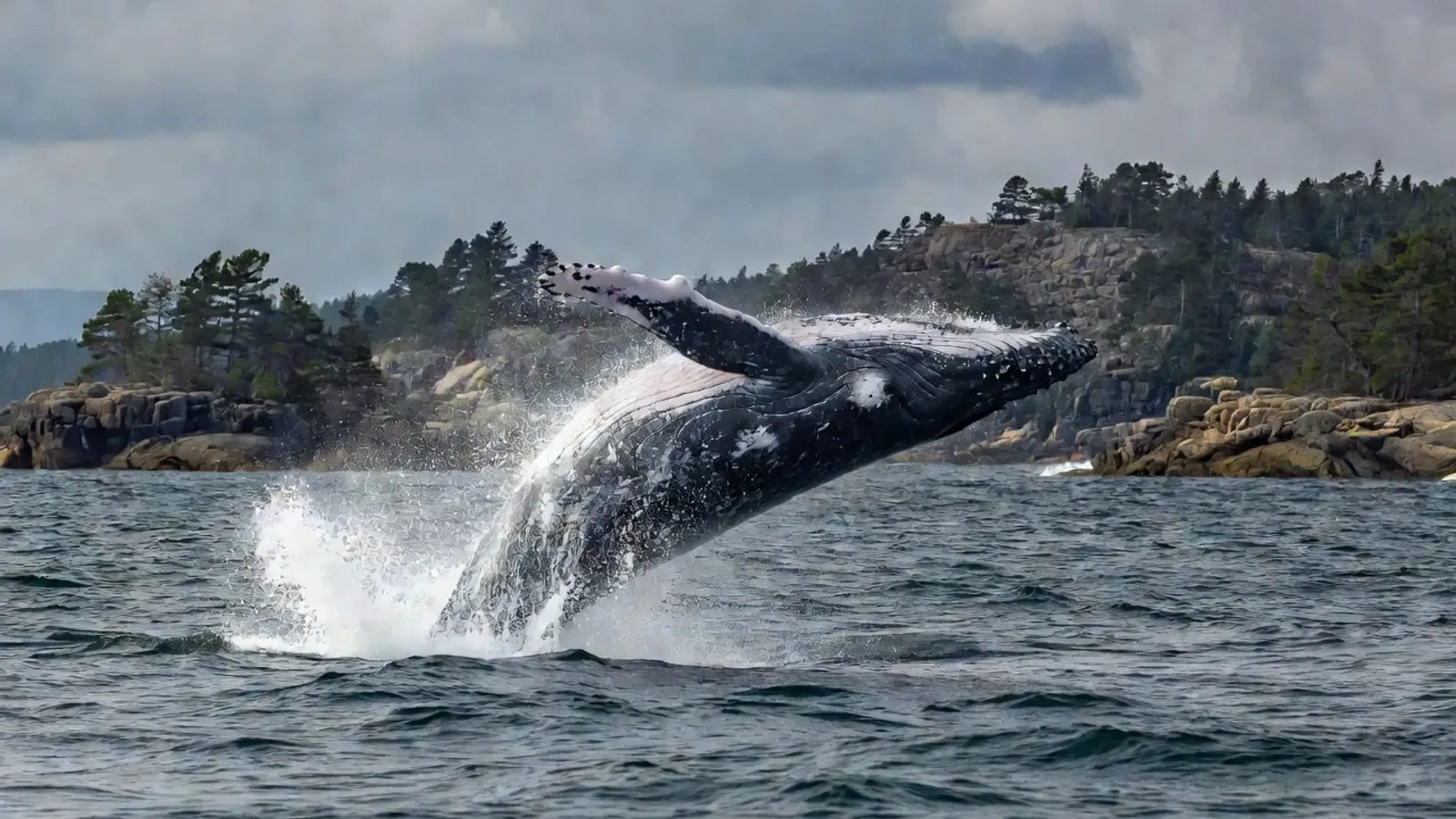
Whale Species & Best Months in Bar Harbor
| Species | January–March | April–June | July–September | October–December | Likelihood |
|---|---|---|---|---|---|
| Humpback Whale | — | Arriving | Peak | Departing | ~95% Jun–Oct |
| Fin Whale | — | Arriving | Common | Departing | ~70% |
| Minke Whale | — | Present | Common | Present | ~60% |
| North Atlantic Right Whale | — | Rare | Rare | — | ~5% |
| Atlantic White-sided Dolphin | — | Present | Common | Present | ~50% |
What to Expect on the Day
Depart Frenchman Bay
Tours depart from the Bar Harbor town pier with Acadia National Park's Cadillac Mountain rising behind the town. The boat heads east through Frenchman Bay — a sheltered coastal inlet ringed by the Porcupine Islands — before entering the open Gulf of Maine. Harbour seals are often visible on the islands as you pass.
Crossing to the feeding grounds
The whale feeding grounds lie 20–30 miles offshore, a 45–60 minute crossing. The open Gulf of Maine can be cold and choppy — this is the part of the trip where motion sickness is most likely. Most passengers find a spot on the main deck and watch the horizon. A naturalist from the College of the Atlantic describes the ecosystem en route.
Humpback whale encounters
Humpbacks are the star of Bar Harbor whale watching. They are acrobatic and curious — breaching, lob-tailing, and occasionally approaching the boat. The naturalist identifies individual whales by the unique black-and-white patterns on the undersides of their flukes. Many have been catalogued for decades, and the naturalist can tell you their history, age, and calf record.
Fin whale sightings
Fin whales — at 75 feet long and 80 tons, the second-largest animals on Earth — are a frequent bonus sighting. They surface in a rhythmic pattern (three blows, then a dive) and can be difficult to approach due to their speed, but on calm days they often linger near feeding concentrations. Their asymmetric jaw colouring (white on the right, dark on the left) is visible close up.
Return through the Porcupine Islands
The return to Bar Harbor through Frenchman Bay offers views of the Porcupine Islands — a string of small, forested islands that appear to be swimming across the bay when viewed from the water. Harbour porpoise and grey seals are frequently spotted on the return. The Acadia skyline makes for dramatic late-afternoon photography.
Watch: Humpback Whales in Bar Harbor
Bar Harbor Whale Watch Adventure
What to Bring — and What to Leave at Home
✓ Bring
- Warm waterproof jacket — Gulf of Maine is cold even in summer
- Fleece mid-layer (required even in July and August)
- Beanie or warm hat
- Binoculars
- Camera with telephoto lens
- Motion sickness medication if prone
✗ Leave at home
- Light summer clothing only — Gulf of Maine temperatures are 30–40°F colder than inland Maine
- Pets
Where Tours Depart From
| Port / Area | Details |
|---|---|
| Bar Harbor Town Pier | 1 West St, Bar Harbor, ME 04609. All major whale watching operators depart from the town pier at the foot of Main Street. Paid parking in the Bar Harbor town lots on Cottage St and Glen Mary Rd (a short walk). Bar Harbor is on the eastern shore of Mount Desert Island. |
How to Choose an Ethical Tour
What ethical operators do
- Maintain 100-yard minimum from all large whales (NOAA regulations)
- North Atlantic right whale sightings should be reported to 1-800-900-3622 immediately — they are critically endangered
- Book operators that carry College of the Atlantic naturalists — they contribute to long-term research
- Choose NOAA-permitted whale watch operators
Red flags to avoid
- Approaching North Atlantic right whales at any distance — federal law requires 500 yards
- Operators without NOAA whale watch permits
- Loud engine noise near feeding whales