

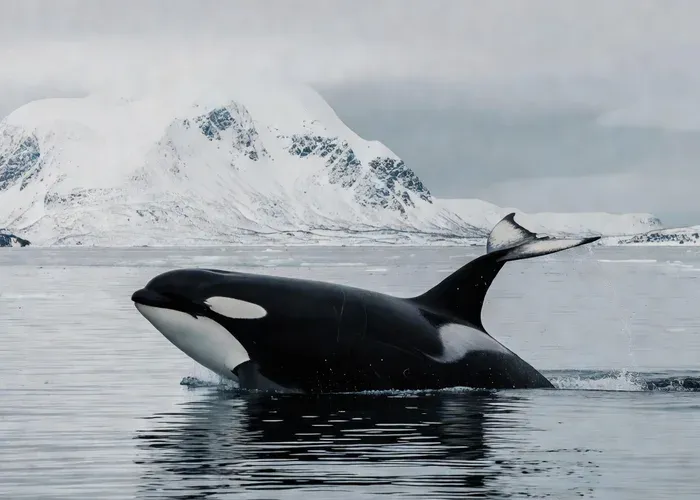
Which Tromsø Whale Watching Tour Is Right for You?
| Tour type | Duration | Group size | Best for | Rating | From | |
|---|---|---|---|---|---|---|
| Skjervøy RIB | 10–12 hrs | Small group | Highest whale density — Skjervøy fjord | 4.8 | $338 | Check → |
| Magic Skjervøy Expedition | Full day | Small group | Premium fjord whale watching | 4.7 | $359 | Check → |
| High-Speed Catamaran | 3–4 hrs | Medium group | City-centre convenience and value | 4.6 | $211 | Check → |
| All-Inclusive Orca Safari | 3–4 hrs | Up to 50 pax | Comfort and everything included | 4.6 | $264 | Check → |
| Hybrid-Electric Boat | 3–4 hrs | Medium group | Best price and most reviews | 4.5 | $210 | Check → |
| MS Gabriele Cabin Vessel | 3–4 hrs | Medium group | Traditional vessel, cold-weather comfort | 4.3 | $211 | Check → |
| MS Alba Responsible Watching | 3–4 hrs | Small–medium group | Conservation-focused travellers | 4.7 | $216 | Check → |
| 24hr Northern Lights & Whale Combo | 24 hours | Solo/private | Ultimate Arctic wildlife experience | 4.9 | $792/group | Check → |
Whale Species & Best Months in Tromsø
| Species | January–March | April–June | July–September | October–December | Likelihood |
|---|---|---|---|---|---|
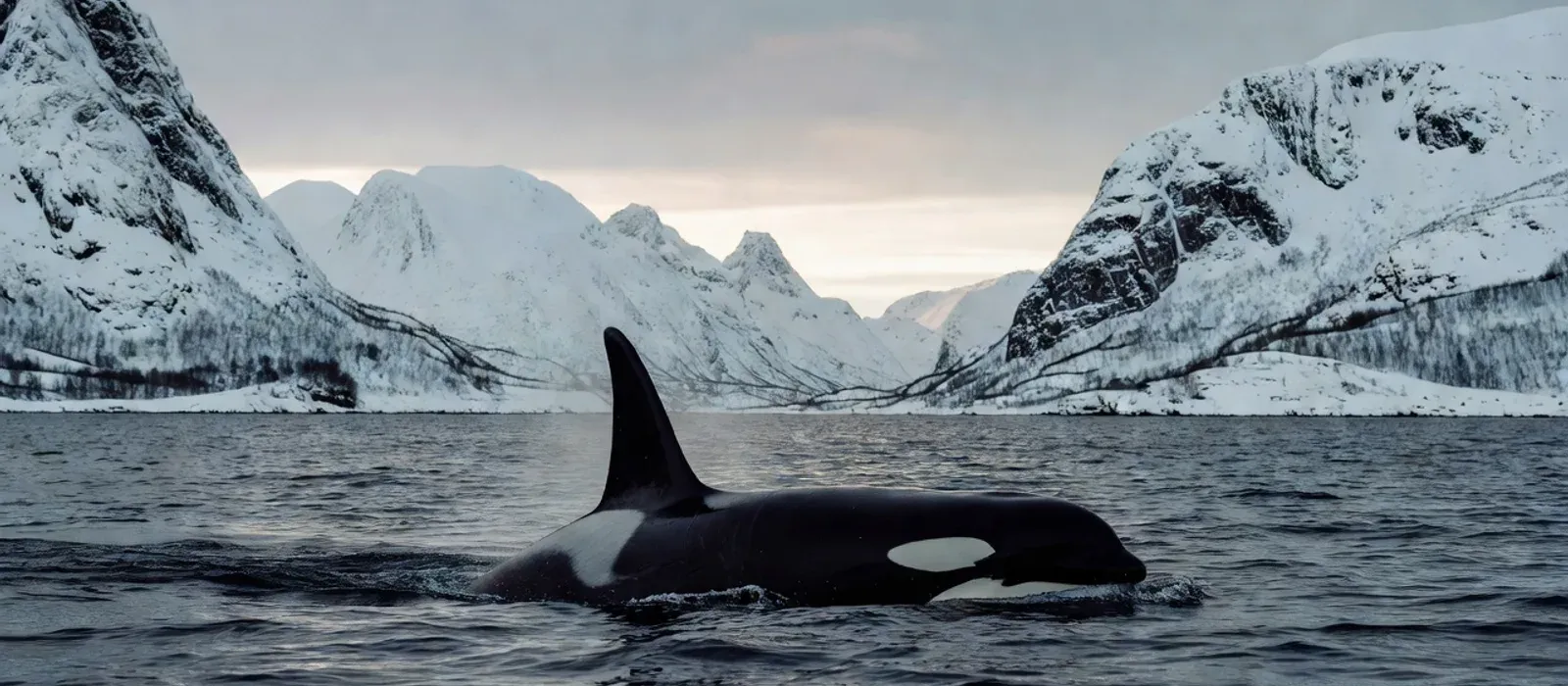
| Orca (Killer Whale) | Present | — | — | Peak | ~90% Nov–Jan |
| Humpback Whale | Present | — | — | Common | ~70% Oct–Feb |
| White-beaked Dolphin | Present | Present | Present | Present | ~40% |
| Fin Whale | Rare | — | — | Rare | ~10% |
What to Expect on the Day
Pre-departure briefing
Operators check current whale reports from scout boats and spotter aircraft before each departure. The herring location moves between fjords — on some days whales are 30 minutes from Tromsø, on others they require 2+ hours of travel north to Skjervøy. Departure times may be adjusted based on overnight reports. Check your operator's app or SMS updates the evening before.
Into the Arctic fjords
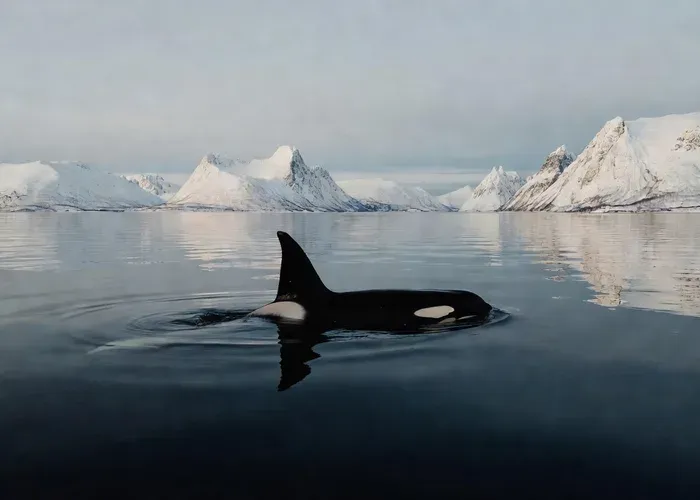
Leaving Tromsø harbour, the boat passes under the Tromsøya Bridge (the world's northernmost suspension bridge) and heads into Kaldfjord or Ullsfjord. In November–December, the fjord landscape is in polar twilight — 2–4 hours of low orange-blue light daily, with the mountains reflected in flat dark water. The crossing to Skjervøy (t1, t2) takes 2 hours over open fjord water — expect spray and cold wind.
Locating the herring school
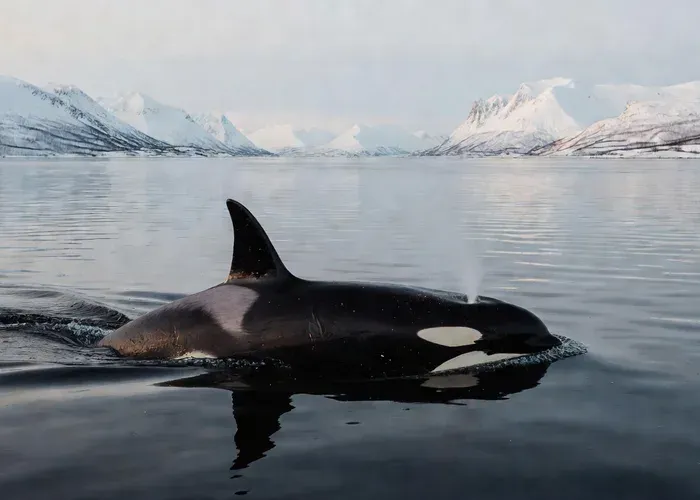
The crew watches for seabird activity — thousands of gulls, gannets, and kittiwakes diving in one location is the most reliable indicator of a herring ball near the surface. Sonar and radio reports from other vessels confirm the location. A dark patch of churning water with silver flashes means the herring are being driven to the surface from below. Orca spouts appear as white puffs above the mass of birds.
Orca carousel feeding
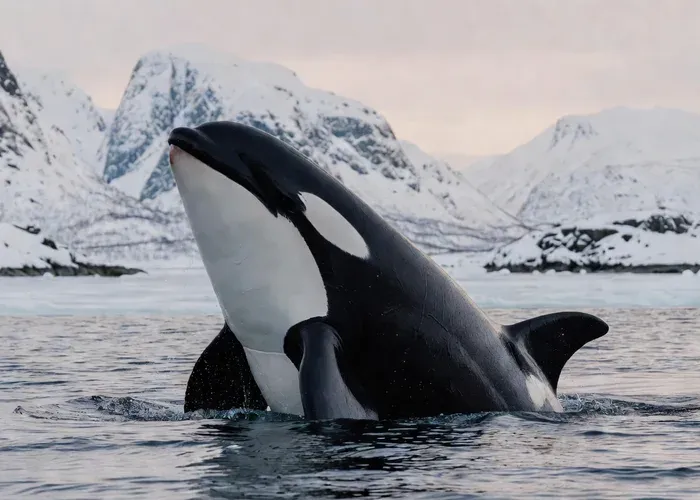
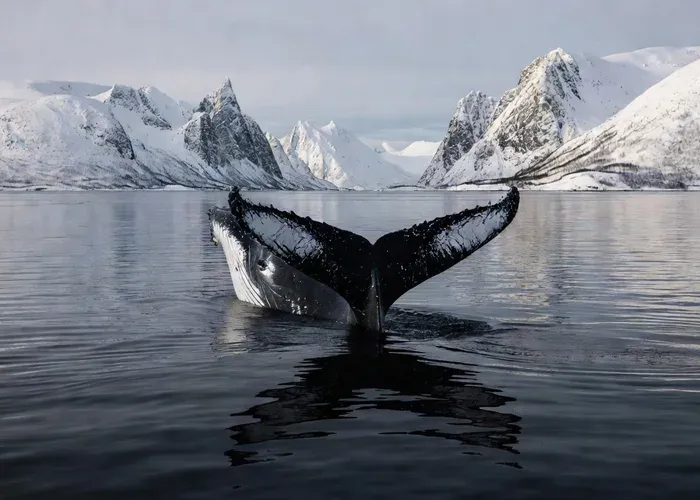
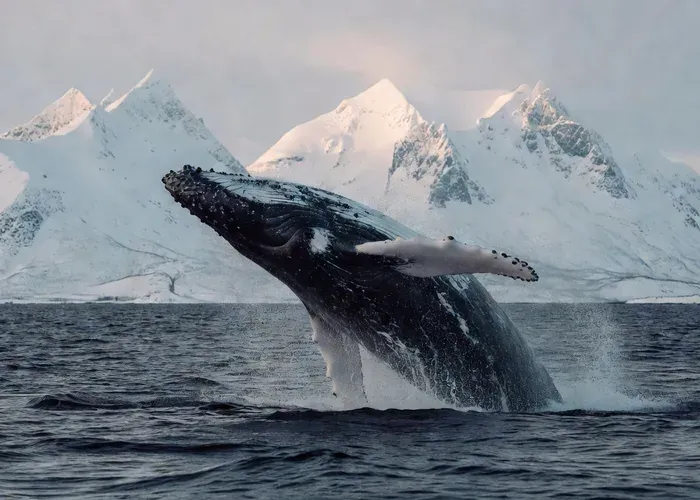
Orca carousel feeding is one of the most extraordinary animal behaviours on Earth. A pod of 10–40 orca works in coordinated shifts: some drive the herring ball from below while others take turns racing through it with mouths open, stunning fish with precise tail slaps. The herring react by compressing into a tight ball — the tighter the ball, the more efficient the hunting. The water turns silver with fish scales. Humpbacks often lunge-feed at the edges of the same herring ball, their barnacle-covered backs emerging alongside orca.
Northern Lights (seasonal)
From November through February, Northern Lights are possible on clear nights after whale watching hours. Tour t8 dedicates 24 hours to the combined experience. Individual whale watching tours (t1–t7) typically return to Tromsø by evening — if conditions are right, the Northern Lights may be visible on the return journey or from the harbour. Geomagnetic activity (KP index 3+) and clear skies are both required. The Tromsø area averages 3–4 clear nights per week in winter.
Watch: Humpback Whales in Tromsø
Incredible Arctic Whale Watching in Tromsø, Norway — Orca & Humpback Tours
What to Bring — and What to Leave at Home
✓ Bring
- Full Arctic waterproof suit (most operators provide flotation overalls — wear thermals underneath)
- Thermal base layer top and bottom
- Fleece mid-layer
- Waterproof gloves rated to -15°C
- Warm hat covering ears
- Waterproof boots with insulated lining
- Seasickness tablets — fjord conditions can be rough, especially on RIB tours
- Camera with fast lens for low Arctic light
✗ Leave at home
- Cotton base layers — cotton stays wet and cold
- Fashion trainers or any non-waterproof footwear
- Drones — illegal near cetaceans in Norway
Where Tours Depart From
| Port / Area | Details |
|---|---|
| Tromsø City Harbour | Prostneset, 9008 Tromsø, Norway. All catamaran, hybrid-electric, and cabin-vessel tours (t3–t8) depart from the city harbour — 15 minutes on foot from Tromsø city centre and 5 minutes from the Clarion Collection hotel district. Free parking nearby. RIB tours (t1, t2) also depart from Tromsø before heading north to Skjervøy. |
How to Choose an Ethical Tour
What ethical operators do
- Choose operators with Norwegian Cetacean Research Institute responsible watching certification
- Engine idle or electric mode when within 100m of orca pods (t5 hybrid-electric is best for this)
- No abrupt acceleration or steering changes within whale feeding areas
- Report any orca entanglement or injury to the Norwegian Institute of Marine Research immediately
Red flags to avoid
- Racing toward orca feeding events reported by other boats — creates vessel congestion around feeding pods
- Playing sound from underwater speakers near orca
- Throwing food or fish waste overboard near whale pods